L-Theanine: the natural anxiolytic from tea that improves focus and sleep
Complete guide to L-theanine. How it works, dosage for anxiety, sleep and ADHD, caffeine combination, best supplements (NOW Foods, Suntheanine) and clinical evidence.
L-theanine is an amino acid found naturally only in the tea plant (Camellia sinensis) and in one mushroom (Boletus badius). It is the reason why green tea relaxes without making you drowsy: L-theanine counteracts the stimulation of caffeine, producing a state of calm alertness that does not exist with coffee alone.
It is not a sedative. It does not induce drowsiness. It promotes alpha brain waves (the same ones produced by meditation), reduces anxiety without affecting cognition, and improves selective attention. It is the natural nootropic with the most evidence for the balance between calm and focus.
Mechanism of action
What L-theanine does in your brain
L-theanine crosses the blood-brain barrier within 30-45 minutes after oral ingestion. Once in the brain:
- Increases alpha waves (8-13 Hz): the brain waves associated with relaxed alertness (meditation, flow state). It does not increase theta waves (drowsiness) or delta waves (deep sleep) during the day
- Modulates neurotransmitters: gently increases GABA (inhibitory, calming), serotonin (well-being), and dopamine (motivation) in a dose-dependent manner
- Inhibits excitatory glutamate: acts as a low-affinity competitive antagonist of the glutamate receptor. Reduces neuronal over-excitation without blocking cognition
- Reduces cortisol: attenuates the physiological stress response (cortisol, heart rate, blood pressure) during stressful tasks
The net result: you are calm but not drowsy. Focused but not anxious. It is the functional opposite of caffeine alone.
Clinical evidence
Anxiety and stress
Hidese et al., 2019 (Nutrients): RCT in 30 healthy adults. 200mg/day of L-theanine for 4 weeks significantly reduced subjective stress, anxiety, and sleep problems. Improvements in depression, anxiety, and sleep quality measured by validated scales.
Sarris et al., 2019 (Journal of Clinical Psychiatry): Double-blind RCT in 46 patients with generalized anxiety disorder (GAD). 450-900mg/day of L-theanine for 10 weeks. Result: L-theanine did not outperform placebo on the primary HAM-A scale, but treated participants reported greater sleep satisfaction and improvement on the Insomnia Severity Index.
Honest interpretation: L-theanine works better for subclinical anxiety and everyday stress than for diagnosed anxiety disorder. It is not a substitute for prescribed anxiolytic medication.
Sleep
Rao et al., 2025 (Nutrients): Recent systematic review (2025) of L-theanine and sleep quality. Most studies showed improvement in subjective sleep measures (onset latency, perceived quality). Effects on objective measures (polysomnography) were less consistent.
Lyon et al., 2011 (Alternative Medicine Review): L-theanine (Suntheanine) improved objective sleep quality in boys with ADHD (ages 8-12). Significant reduction in sleep onset latency and increase in total duration. One of the few studies with objective actigraphy.
Cognition and attention
Kahathuduwa et al., 2022 (Nutritional Neuroscience): Systematic review of L-theanine + caffeine for cognitive function. The combination consistently improved attention and processing speed. L-theanine alone improved selective attention on some measures.
Sievert et al., 2025 (Psychopharmacology): L-theanine 400mg + caffeine 200mg improved selective attention in young adults with acute sleep deprivation. Effect superior to placebo and caffeine alone as measured by EEG and cognitive tests.
ADHD
The evidence for ADHD is preliminary but promising. L-theanine improves attention and reduces hyperactivity through glutamatergic modulation and alpha wave increase. It is not a first-line treatment, but it is a safe complement that some psychiatrists recommend alongside standard medication.
“L-theanine promotes relaxation without drowsiness. Unlike conventional anxiolytics, it does not impair cognitive function or cause sedation. The increase in alpha brain waves is consistent with a state of wakeful relaxation, similar to meditation.”
The L-theanine + caffeine stack
The most studied combination in nootropics. Caffeine provides alertness and energy; L-theanine eliminates the negative effects (nervousness, anxiety, crash).
The optimal ratio
2:1 (L-theanine:caffeine) is the ratio most supported by evidence.
| Combination | Effect | For whom |
|---|---|---|
| 200mg L-theanine + 100mg caffeine | Calm focus, productivity | Daily use, cognitive work |
| 400mg L-theanine + 200mg caffeine | Maximum performance | Sleep deprivation, exams |
| 200mg L-theanine + coffee (1 cup) | The practical version | The easiest stack |
Why it works
- Caffeine blocks adenosine receptors (wakes you up) but also activates the sympathetic system (nervousness, tachycardia)
- L-theanine reduces sympathetic activation without blocking caffeine's alertness effect
- Result: the cognitive benefits of caffeine without the side effects
The natural equivalent: matcha
Ceremonial matcha naturally contains ~30-50mg of caffeine + ~20-30mg of L-theanine per cup. It is the natural version of the stack. But the L-theanine concentration is too low for significant anxiolytic effect. For therapeutic effect, supplementing is more effective.
Dosage by goal
| Goal | L-theanine dose | Timing | Duration |
|---|---|---|---|
| Everyday anxiety | 200mg, 1-2x/day | Morning and/or afternoon | Continuous |
| Sleep | 200-400mg | 30-60 min before bed | Continuous |
| Focus + coffee | 200mg with each coffee | With coffee | As needed |
| Acute stress | 200mg | In the moment | As needed |
| ADHD (complement) | 200-400mg/day | Divided morning/afternoon | Continuous, consult doctor |
| Exams/performance | 400mg + 200mg caffeine | 45 min before | As needed |
Safety
L-theanine is extremely safe. There are no reports of toxicity at doses up to 900mg/day in clinical studies. It does not create dependence. It has no rebound effect. It does not interact significantly with common medications. The FDA classifies it as GRAS (Generally Recognized As Safe).
In pregnancy: there is not enough data. Caution is recommended (avoid supplementation; green tea in normal amounts is considered safe).
The best L-theanine supplements
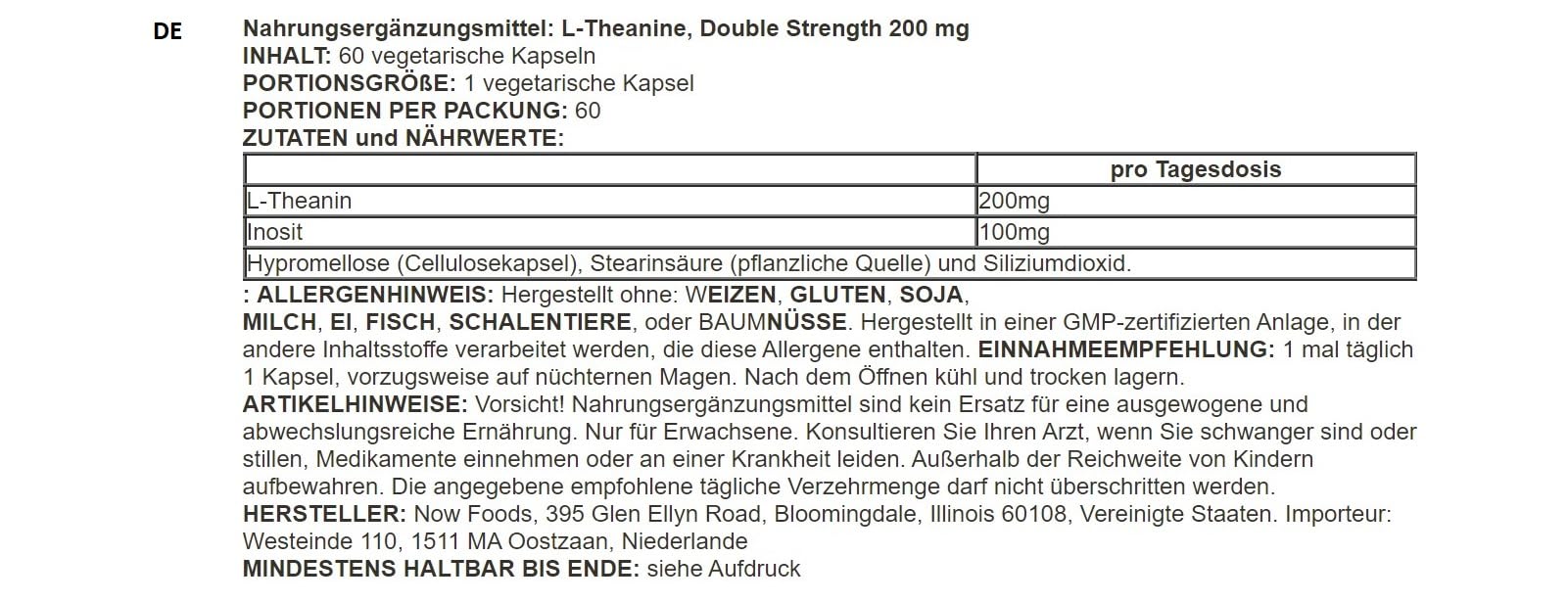
NOW Foods L-Theanine 200mg
200mg of L-theanine + 100mg of inositol per capsule. NOW Foods, the supplement brand with the most quality certifications. 60 vegan capsules, one capsule per day dose.

Life Extension L-Theanine 100mg
100mg per capsule for adjustable dosing. Life Extension is the premium longevity brand. Allows dosing 100-400mg as needed (1-4 caps). Ideal if you want to start low.
L-theanine vs other natural anxiolytics
| Active | Mechanism | Evidence | Sedating? | Interactions |
|---|---|---|---|---|
| L-theanine | Alpha waves, GABA, glutamate | Moderate (RCTs) | No | Minimal |
| Magnesium glycinate | GABA, muscle relaxation | Strong | Mild at night | With antibiotics |
| Ashwagandha | Cortisol, GABA-A | Moderate-strong | No | With thyroid meds |
| GABA supplement | Direct GABA | Weak (does not cross BBB well) | Not significant | Minimal |
| Valerian | GABA-A | Moderate | Yes | With sedatives |
| CBD | Endocannabinoid | Emerging | Variable | With CYP450 |
L-theanine has the unique advantage of reducing anxiety without sedation. It is the only one that improves cognition while calming. The others either sedate (valerian, magnesium at night) or have no cognitive effect (ashwagandha).
Synergies
| Combination | Effect |
|---|---|
| L-theanine + caffeine | Calm focus (the most studied stack) |
| L-theanine + magnesium glycinate | Deep sleep (dual GABA) |
| L-theanine + ashwagandha | Complete anti-stress (cortisol + alpha waves) |
| L-theanine + omega-3 | Neuroprotection + calm |
| L-theanine + melatonin | Rapid sleep onset (combine with caution, may be excessive) |
When NOT to use L-theanine
- As a substitute for psychiatric medication: L-theanine is a complement, not a treatment for GAD, depression, or ADHD
- To sleep if the problem is sleep apnea: you need a diagnosis, not supplements
- In combination with benzodiazepines: additive sedation effect (consult doctor)
- Pregnancy: insufficient data for supplementation (normal green tea is acceptable)
Common mistakes
1. Dose too low
100mg may not be enough for anxiolytic effect. Most positive studies used 200-400mg. If 100mg does nothing, increase to 200mg before giving up.
2. Expecting a sedative effect
L-theanine will not knock you out like melatonin or valerian. It relaxes without sedating. If you need a knockout for sleep, combine with magnesium glycinate.
3. Not combining it with caffeine
L-theanine alone is useful, but its optimal effect is in combination with caffeine. If you drink coffee and experience nervousness, add L-theanine. It is more effective than quitting coffee.
4. Buying brands without certification
L-theanine is an amino acid that should be pharmaceutical grade. Cheap brands without certification may contain lower concentrations than declared. NOW Foods, Life Extension, and Suntheanine are the brands with the most verification.
L-Theanine: best options
| Precio |
“L-theanine at 200mg is the smartest natural anxiolytic that exists. It does not put you to sleep; it calms you while maintaining focus. With coffee it is transformative: all the energy of caffeine without the nervousness. At $8/month with NOW Foods, it is one of the supplements with the best benefit/risk/cost ratio. For sleep, combine with magnesium glycinate. For performance, combine with caffeine.”
Buy in the US
NOW Foods L-Theanine 200mg + Inositol (60 caps)Amazon Life Extension L-Theanine 100mg (60 caps)Amazon NOW Foods L-Theanine 200mg (60 caps, alternative format)AmazonLas fuentes incluyen instituciones médicas, revistas peer-reviewed y organizaciones de investigación. Aevum no ofrece consejo médico.
Aevum Briefing
Every week: one protocol, one evidence analysis and what matters in longevity. No noise. Straight to your inbox.
Complete protocols, curated stacks and in-depth biomarker analysis.